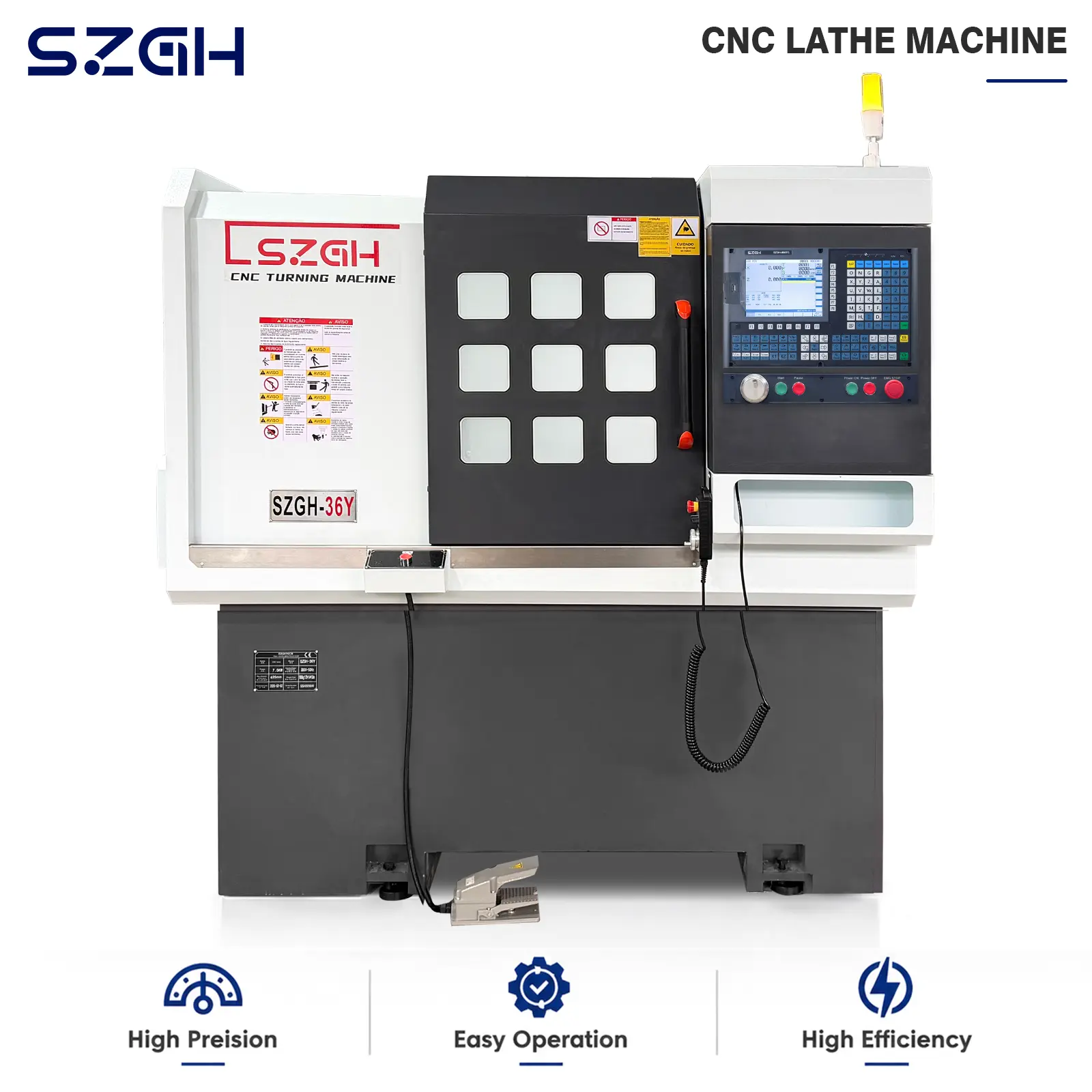
Batch production requires more than producing one accurate component. Manufacturers must repeat the same operations, maintain dimensional consistency, control labor time, and deliver the required quantity on schedule. For workshops making shafts, bushings, pins, fittings, and other turned metal parts, choosing between a small CNC lathe and a conventional lathe can directly affect production efficiency and cost.
A conventional lathe relies mainly on the operator to control tool movement and machining steps. A small CNC lathe uses a programmed control system to coordinate axis movement and execute repeatable machining cycles. Both machines have a place in modern workshops. The better choice depends on batch size, part complexity, tolerance requirements, labor availability, and investment budget.
1. How the Two Lathe Types Work
A conventional lathe is manually operated. The machinist sets the workpiece, selects cutting tools, adjusts feeds and speeds, and controls the cutting process using handwheels, levers, and machine controls. This offers flexibility for one-off jobs, repairs, and parts that require frequent manual adjustment.
A small CNC lathe uses a CNC controller and servo-driven axes to follow a machining program. After the program, tooling, and workholding have been properly set up, the machine can repeat the same sequence across a batch. Many compact CNC lathes use a two-axis X and Z configuration for common turning operations.
The key difference is not simply machine size. It is how much of the machining process is controlled manually and how much is automated through a stored program.
2. Production Consistency Across a Batch
Consistency is one of the strongest reasons to consider CNC turning for repeat production. On a conventional lathe, dimensions can vary with operator technique, measurement frequency, tool adjustment, and fatigue. An experienced machinist can produce excellent parts, but maintaining the same result over a long run requires careful control.
A CNC lathe repeats programmed tool paths and cutting sequences. Once the first part has been tested and offsets have been adjusted, the same program can be used for subsequent parts. This helps reduce variation between operators and across repeated batches.
CNC does not remove the need for quality control. Tool wear, thermal changes, material variation, workholding, and incorrect offsets can still affect dimensions. First-piece inspection and regular in-process checks remain important.
3. Cycle Time and Labor Efficiency
For batch production, total cycle time includes more than the time when the cutting tool is in contact with the material. Loading, clamping, tool positioning, measuring, tool changes, and unloading all affect output.
A conventional lathe requires the operator to control many movements manually. This can be efficient for simple parts or short runs, especially when an experienced machinist can complete the job without extensive setup.
A CNC lathe can automate repeated movements and execute multiple operations in a programmed sequence. The operator can spend more time loading parts, checking dimensions, monitoring tool condition, and preparing the next batch. When the same component is produced regularly, saved programs also reduce the need to recreate the machining sequence each time.
Actual productivity depends on the part, cutting parameters, tooling, workholding, and operator workflow. A CNC machine is not automatically faster for every job, particularly when a batch is very small or setup and programming take longer than machining.
4. Flexibility and Setup for Different Jobs
Conventional lathes are useful when a workshop handles one-off repairs, prototypes, and frequently changing jobs. A skilled operator can adjust the process directly without writing or editing a CNC program.
CNC lathes are also flexible, but their advantage is strongest when jobs repeat. Programs, tool offsets, and setup records can be stored and reused. For a new part, the workshop may need programming, tool selection, workholding preparation, and trial machining before production begins.
For mixed production, manufacturers should consider how often jobs change and how many parts are required per setup. A small CNC lathe can handle different components, but the economic benefit increases when programs and setups are reused.
5. Comparing Costs for Batch Production
The purchase price is only one part of the decision. A conventional lathe generally has a lower initial investment, while a CNC lathe may require additional spending on the controller, servo system, tooling, training, and maintenance.
However, the total cost per accepted part may change as batch size increases. CNC turning can reduce repetitive operator involvement and make recurring production more predictable. It may also reduce rework when the process is properly developed.
Cost factor | Conventional lathe | Small CNC lathe |
Initial investment | Usually lower | Usually higher |
Programming | Not normally required | Required for CNC jobs |
Operator involvement | High during machining | More focused on supervision and handling |
Repeatability | Depends strongly on operator and setup | Program-based, with process control still required |
Best cost opportunity | One-off and very small batches | Repeated and larger batches |
Setup considerations | Manual adjustment | Program, tooling, offsets, and workholding |
To compare fairly, calculate the cost of a complete batch. Include programming and setup time, labor, cycle time, tooling, scrap, inspection, maintenance, and machine downtime. The break-even batch size varies by component and workshop; there is no universal quantity at which CNC always becomes cheaper.
6. Which Parts Are Better Suited to Each Machine?
A conventional lathe may be suitable for simple shafts, spacers, bushings, and repair components produced in very small quantities. It is also useful when the drawing changes frequently or the job requires experienced manual judgment.
A small CNC lathe is often more suitable for recurring parts with multiple diameters, shoulders, grooves, chamfers, or threads. It is especially valuable when the same component must be produced in batches with consistent dimensions.
For bar-fed production, check the spindle bore and maximum bar capacity. For chuck-based parts, review the maximum turning diameter, workpiece length, chuck size, and clamping method. If parts require off-center drilling, side milling, or other operations beyond standard turning, a live-tool or turn-mill configuration may be more suitable than a basic two-axis lathe.
7. Choosing a Small CNC Lathe for Batch Production
Machine selection should start with actual part drawings and production data rather than the machine's advertised maximum capacity alone.
For example, the SZGH-36J is a compact two-axis slant-bed CNC lathe designed for small and medium-sized precision turning. Its published specifications include a maximum bar capacity of 35 mm, a 4 kW spindle motor, X-axis travel of 600 mm, Z-axis travel of 230 mm, and workpiece accuracy of ±0.01 mm. It may be considered for repeat production of small shafts, bushings, pins, and fittings, subject to the final configuration and machining test.
For larger bar components, the SZGH-46J supports bar material up to 45 mm. Published product information lists a 5.5 kW spindle motor and workpiece accuracy of ±0.0075 mm. It may suit workshops producing larger fittings, sleeves, and precision mechanical components.
These are reference specifications, not guaranteed results for every material or cutting condition. Actual performance depends on workpiece material, tooling, clamping, machine configuration, cutting parameters, and inspection methods.
Before purchasing, confirm the maximum workpiece dimensions, bar capacity, spindle speed and power, chuck type, tool stations, controller, automation options, installation requirements, and after-sales support. A sample machining test using the customer's material and drawing is a practical way to evaluate suitability.
8. When Should You Upgrade?
A workshop should consider upgrading from a conventional lathe when repeat orders are increasing, operators spend too much time repeating manual movements, dimensional variation is causing rework, or delivery schedules are becoming difficult to maintain.
A CNC lathe may not be necessary for every machine in the workshop. A practical approach is to identify the parts with the highest repeat volume and most stable designs, then evaluate whether CNC production can lower their total cost per accepted part.
Conventional lathes can remain valuable for repairs, prototypes, and low-quantity custom work, while a CNC lathe handles recurring production. Using both machine types can be a sensible transition strategy.
Conclusion
For batch production, a small CNC lathe is generally the stronger choice when parts repeat, dimensions must remain consistent, and production volume justifies programming and setup. A conventional lathe remains practical for one-off jobs, repairs, prototypes, and very small batches where manual flexibility matters more than repeat automation.
The best decision comes from comparing the complete production cost and the requirements of the actual workpiece. Review batch quantity, cycle time, tolerances, material, tooling, and operator availability before investing.
Looking for a small CNC lathe for batch production?
Explore SZGH CNC lathe solutions and share your part drawings, material, bar diameter, and expected batch quantity with our team. We can help you evaluate a suitable machine configuration for your production needs.