Turning Center vs Machining Center Which Is Right for Your Production?
Introduction
Choosing between a turning center and a machining center is an important decision for manufacturers investing in CNC equipment. The right machine can improve production efficiency, maintain consistent part quality, and reduce manufacturing costs. The wrong choice may result in unnecessary investment, additional setups, or inefficient use of workshop capacity.
The main difference in the turning center vs machining center comparison is how each machine removes material. A turning center primarily rotates the workpiece while a cutting tool removes material. A machining center typically rotates the cutting tool while the workpiece is secured to a table or fixture.
However, the best machine depends on more than its cutting principle. Workpiece geometry, required operations, production volume, tooling, and future manufacturing plans all influence the final decision.
What Is a Turning Center
A turning center is a CNC machine designed primarily for machining rotational components. The workpiece is held in a chuck or collet and rotated by the spindle while cutting tools move along programmed axes to produce the required dimensions and surfaces.
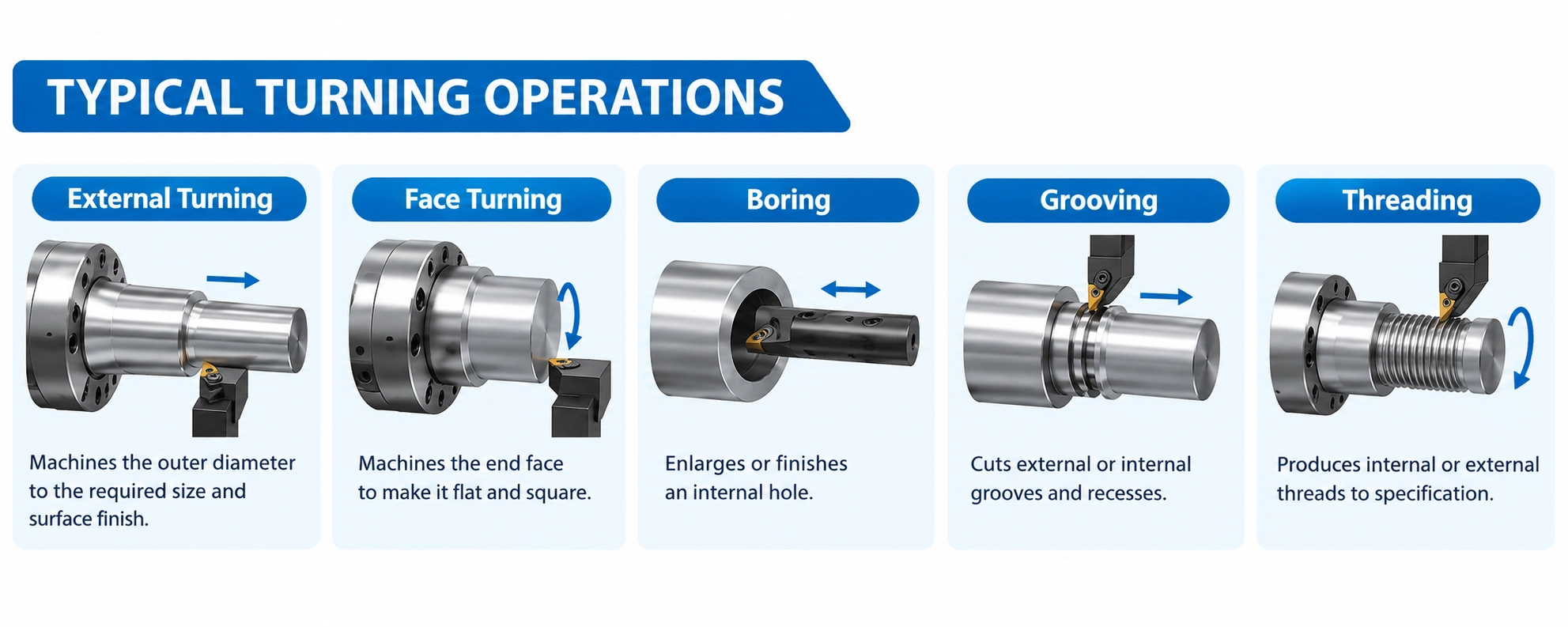
Common operations include external turning, facing, boring, grooving, and threading. Depending on its configuration, a turning center may also support powered milling tools and additional axes for machining features that would otherwise require another machine.
Typical Applications of Turning Centers
Turning centers are commonly used to manufacture:
Shafts, pins, bushings, and cylindrical components
Brass and steel fittings
Hydraulic and pneumatic connectors
Threaded components and precision fasteners
Rotational parts for automotive and industrial equipment
For example, a manufacturer producing metal fittings from bar stock may benefit from a CNC turning center with suitable spindle capacity and an automatic bar feeder. Once the program and tooling are established, the machine can produce repeated components with consistent machining cycles.
The SZGH-36J CNC lathe supports bar machining up to 35 mm in diameter under its specified configuration. It is a potential option for manufacturers producing smaller rotational components, provided that the required workpiece dimensions and operations match the machine's actual capabilities.
Explore the SZGH-36J CNC Lathe.
What Is a Machining Center
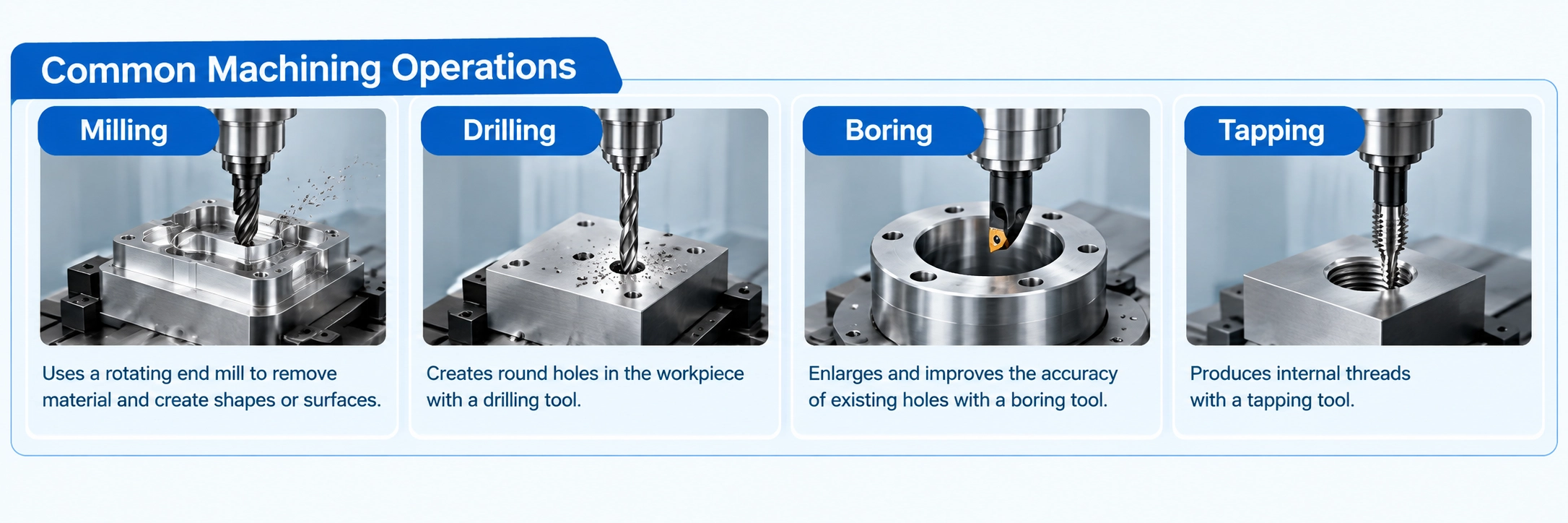
A CNC machining center performs multiple cutting operations, typically including milling, drilling, boring, reaming, and tapping. The cutting tool rotates in the spindle while the workpiece is secured to the machine table or a suitable fixture.
Many machining centers include an automatic tool changer. This allows different tools to be selected according to the programmed sequence, reducing manual tool changes when a component requires several operations.
Typical Applications of Machining Centers
Machining centers are suitable for producing:
Machine housings and structural components
Plates, brackets, and mounting blocks
Mold and die components
Aluminum enclosures with pockets and holes
Parts requiring machining across multiple surfaces
For example, an aluminum housing may require milled faces, mounting holes, internal pockets, and tapped holes. A vertical machining center can perform several of these operations in one setup, depending on the part geometry, tooling, and workholding arrangement.
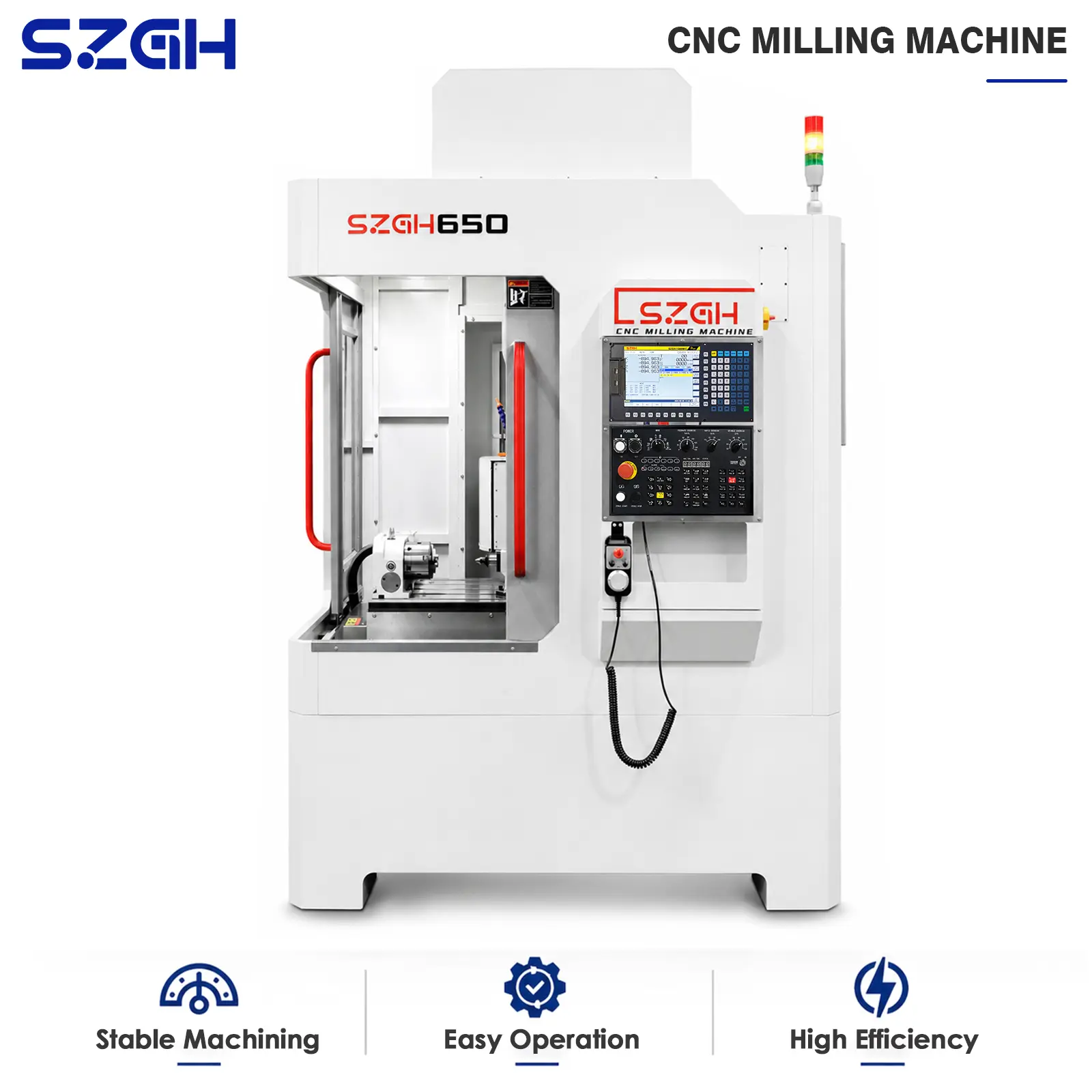
The SZGH-VMC650 is designed for operations including drilling, milling, boring, expanding, reaming, and rigid tapping. Its suitability for a particular job should be confirmed by checking the required workpiece dimensions, travel, spindle specifications, tooling, and selected configuration.
Explore the SZGH-VMC650 Vertical Machining Center.
Turning Center vs Machining Center Key Differences
The following comparison highlights the main differences manufacturers should consider when selecting CNC equipment.
Factor | Turning Center | Machining Center |
Main cutting principle | Workpiece rotates | Cutting tool rotates |
Typical workpieces | Shafts, bushings, fittings | Housings, plates, brackets, molds |
Common operations | Turning, facing, grooving, threading | Milling, drilling, boring, tapping |
Workholding | Chuck, collet, or specialized fixture | Table, vise, or dedicated fixture |
Typical tooling | Turning tools, boring bars, threading tools | End mills, drills, taps, boring tools |
Main advantage | Efficient production of rotational parts | Flexible machining of multiple features |
Key capacity checks | Bar diameter, turning diameter, workpiece length | Axis travel, table size, workpiece weight |
Additional capabilities | Powered tooling on suitable models | Rotary tables or additional axes on suitable models |
These distinctions are general rather than absolute. A turning center equipped with powered tools can perform selected milling operations, while a machining center with a suitable rotary axis can machine certain angled or multi-sided features.
How to Choose the Right CNC Machine
1. Start With Workpiece Geometry
Workpiece geometry is one of the most important factors in CNC machine selection.
If a component is primarily cylindrical and requires turning, a turning center is usually the logical starting point. Typical examples include shafts, threaded connectors, bushings, and round fittings.
If the component has extensive flat surfaces, pockets, slots, and drilled holes, a machining center is generally more suitable.
For parts combining cylindrical and milled features, compare a conventional turning center and machining center workflow with a turn mill solution. The best option depends on how much material removal each operation requires and whether the combined configuration can complete the part efficiently.
2. List All Required Machining Operations
Review the engineering drawing and identify every required operation, including turning, milling, drilling, tapping, threading, and grooving.
Then determine how many setups each machine option requires. Every additional setup can introduce loading time, alignment work, and opportunities for positioning errors.
A turning center with suitable powered tooling may complete certain side holes, flats, or slots without transferring the part to another machine. However, a standard two-axis lathe should not be assumed to support these functions. Confirm the available axes, tool positions, spindle functions, and controller capabilities before purchasing.
3. Match Machine Capacity to the Part
A machine must accommodate the complete workpiece and the cutting process required to produce it.
For a turning center, check the maximum bar diameter, turning diameter, machining length, chuck size, spindle speed, and spindle power. Also consider whether the part requires special workholding or automatic feeding.
For a machining center, check X, Y, and Z travel, table dimensions, maximum workpiece weight, spindle taper, spindle speed, and tool magazine capacity.
Do not select a machine based on one specification alone. A large table does not automatically mean a part can be machined efficiently, and high spindle speed is not a substitute for suitable torque, tooling, rigidity, or cutting parameters.
4. Consider Production Volume and Product Variety
For repeated production of rotational components, a turning center with suitable tooling and workholding can provide an efficient workflow. Bar feeding may further reduce manual loading when the workpiece and machine configuration support it.
For workshops producing different housings, plates, and components with varied milled features, a machining center may offer greater flexibility.
Production volume is not the only consideration. A high-volume component with complex milled features may still require a machining center, while a small workshop producing the same turned component repeatedly may benefit from a dedicated CNC lathe.
5. Evaluate Accuracy and Surface Finish
Required tolerances and surface finish should be considered before choosing the machine.
The final result depends on machine condition, workholding, tool quality, material properties, thermal stability, programming, and cutting parameters. Catalog accuracy figures should therefore be treated as machine specifications, not a guarantee that every part will meet a particular tolerance.
Where tolerances are demanding, provide the supplier with engineering drawings and discuss the actual machining process, inspection method, and production conditions.
Turning Center vs Machining Center Cost Comparison
The purchase price is only one part of the investment. Manufacturers should compare the total cost of producing an acceptable component.
Consider these factors:
Machine investment: Compare complete configurations rather than base prices alone.
Tooling and fixtures: Include toolholders, cutters, chucks, collets, and dedicated fixtures.
Setup and programming: Consider the time needed to prepare each job and switch between product types.
Cycle time: Include cutting, loading, tool changes, and workpiece transfers.
Labor and automation: Assess whether bar feeding, automatic tool changing, or other automation can reduce manual intervention.
Quality costs: Consider scrap, rework, inspection, and the ability to maintain consistent dimensions.
Maintenance and support: Evaluate spare parts, technical assistance, training, and routine maintenance requirements.
A turning center may reduce the cost per part for repeated rotational components. A machining center may be more economical for components requiring multiple milling and drilling operations. The better investment is the machine that delivers the required quality and throughput at an acceptable total cost.
When Should You Choose a Turn Mill Machine
Some components require both turning and milling, making a turn mill machine worth considering. These machines combine turning with selected milling, drilling, or tapping functions in one integrated configuration.
This approach can reduce workpiece transfers and help maintain the positional relationship between turned and milled features. It may be especially useful for rotational parts that also require side holes, flats, slots, or end-face machining.
The SZGH-36Y incorporates four side power heads for turning and milling applications. The SZGH-46Y uses a configuration with four side power heads and four end power heads, together with an eight-station servo turret. Both models are designed for suitable components requiring combined operations; the exact capabilities depend on the confirmed configuration.
Explore the SZGH-36Y Turning and Milling Machine and the SZGH-46Y Turning and Milling Machine.
A turn mill machine is not automatically the best solution for every mixed-operation component. Compare its purchase cost, programming requirements, tooling, cycle time, and utilization with the alternative of using separate machines.
Frequently Asked Questions
1.Is a turning center better than a machining center for mass production
A turning center is often suitable for repeated production of rotational parts, while a machining center may be better for components with multiple milled features. The correct choice depends on part geometry, tooling, cycle time, and production requirements.
2.Can a machining center produce cylindrical parts
Yes. A machining center can create cylindrical features using milling, boring, interpolation, and suitable rotary-axis operations. For parts dominated by turning operations, however, a dedicated turning center may provide a more direct workflow.
3.Can a turning center perform milling
Some turning centers support milling through powered tools and additional axes. These functions depend on the machine configuration and should be confirmed before ordering.
4.Which CNC machine is more cost effective
Neither machine is universally more economical. Compare the complete investment, tooling, setup time, cycle time, labor, quality requirements, and maintenance costs for the actual part.
5.What information is needed to select a CNC machine
Provide the part drawing, material, dimensions, tolerances, surface-finish requirements, annual production volume, and required operations. Also specify whether the workpiece comes from bar stock, billets, or castings.
Conclusion
The turning center vs machining center decision should start with the part and its manufacturing process.
A turning center is generally suitable for rotational components requiring efficient turning. A machining center is usually better for parts requiring milling, drilling, tapping, and machining across multiple surfaces. When a component requires substantial turning and milling, an integrated turn mill machine may reduce setup changes and simplify production.
Before investing, compare the workpiece drawing with machine capacity, tooling, workholding, accuracy requirements, and expected output. Contact SZGH with your component drawings and machining requirements to discuss a suitable CNC machine configuration for your production needs.