Additive manufacturing builds a component by adding material layer by layer. Subtractive manufacturing removes material from a workpiece through processes such as milling, turning, drilling, and grinding. Rather than treating these methods as alternatives, manufacturers can combine them in a hybrid workflow: additive processes create a complex or near-net-shape part, and CNC machining finishes the features that require tighter dimensional control.
This approach is useful when a component is difficult to produce efficiently using only one process. However, it is not automatically the best choice for every part. The geometry, material, tolerances, production quantity, and total process cost must all be considered.
1. What Is Additive Manufacturing?
Additive manufacturing, commonly called 3D printing, creates a component from a digital model by depositing or consolidating material in successive layers. Metal additive manufacturing includes several technologies:
Laser Powder Bed Fusion (LPBF): A laser selectively melts metal powder layer by layer.
Directed Energy Deposition (DED): Material is deposited while an energy source melts it onto a substrate or existing component.
Binder Jetting: A binding agent is selectively deposited onto powder, followed by processing such as curing and sintering.
Wire Arc Additive Manufacturing (WAAM): An electric arc melts wire material to build larger structures.
Additive manufacturing offers design freedom. It can produce complex shapes, internal channels, lightweight structures, and integrated features that may be difficult to machine conventionally. For suitable parts, it can also reduce material removal from a solid billet.
However, a printed component is not necessarily ready for use. Depending on the process and application, it may need support removal, heat treatment, powder removal, surface finishing, dimensional correction, or CNC machining.
2. What Is Subtractive Manufacturing?
Subtractive manufacturing creates a part by removing unwanted material from a workpiece. CNC machining is a widely used form of subtractive manufacturing. A computer numerical control system guides cutting tools along programmed paths to perform operations such as:
CNC milling and profile machining
CNC turning and facing
Drilling, boring, and reaming
Tapping and thread machining
These processes are particularly useful for producing accurate holes, flat reference surfaces, bearing seats, threads, sealing faces, and other functional features. For example, a metal housing may have a complex external shape, but its mounting holes and bearing seats must meet specific drawing requirements. CNC machining can finish these features after the basic component has been produced.
Subtractive machining removes material from a larger workpiece, which can mean long cycles and material waste for parts with complex internal geometries.
3. Additive vs Subtractive Manufacturing
The appropriate choice depends on the part and its production requirements.
Comparison | Additive manufacturing | Subtractive manufacturing |
Basic principle | Adds material layer by layer | Removes material from a workpiece |
Design freedom | Suitable for complex geometries | Depends on tool access and machine capability |
Material use | Can reduce waste for suitable designs | Produces chips and removed material |
Precision finishing | Often needs post-processing | Well suited to precision machining |
Typical strengths | Complex shapes and near-net-shape parts | Accurate holes, surfaces, threads, and fits |
Key considerations | Build time, material, supports, and post-processing | Setup, tooling, cycle time, and material removal |
Neither method is universally superior. Additive manufacturing can simplify the creation of certain complex geometries, while CNC machining remains an effective choice for many conventional metal parts and precision features.
4. Why Combine the Two Processes?
A hybrid workflow allows each technology to perform the tasks it handles best.
More design flexibility: Additive manufacturing can create internal passages, lightweight structures, and integrated features. CNC machining can then finish accessible surfaces and interfaces that require controlled dimensions.
Less machining stock: A near-net-shape printed component may require less material removal than a part machined entirely from a solid block. This can be valuable when working with expensive alloys. Actual savings depend on support structures, build orientation, machining allowances, and part geometry.
Accurate functional features: Bearing seats, sealing surfaces, mounting faces, and threaded holes may need machining after printing. CNC operations provide a controlled way to bring these features to their specified dimensions.
Flexible product development: The combined process can help manufacturers develop customized or low-volume components with complex shapes while retaining conventional machining for critical interfaces.
Balance these benefits against printing, post-processing, workholding, machining, and inspection costs.
5. How a Hybrid Manufacturing Workflow Works
A hybrid workflow requires coordinated planning across several stages.
Step 1: Design and process planning
Engineers create the component model using CAD software. They decide which features are suitable for additive manufacturing and which need machining. Machining allowances, datum surfaces, support requirements, clamping positions, and inspection points should be considered before production.
Step 2: Additive manufacturing
The component is built using an appropriate additive process. Technology and material selection depend on the geometry, mechanical requirements, application, and available production equipment.
Step 3: Post-processing
The part may require support removal, stress relief, heat treatment, powder removal, or other preparation. The exact steps depend on the additive process and material.
Step 4: CNC machining
The component is secured on a suitable CNC machine. Milling, drilling, boring, tapping, or turning operations finish selected features. Targets include mounting faces, holes, bearing seats, threads, and sealing surfaces.
Step 5: Inspection
The finished component is checked against its engineering drawing. Inspection covers critical dimensions, tolerances, surface quality, and material properties. A machined surface alone does not prove the entire printed part meets requirements.
6. Where Are Hybrid Approaches Used?
Hybrid manufacturing is most relevant when complex geometry must coexist with precision functional features.
Aerospace: Lightweight structures, specialized brackets, and cooling passages may be produced additively, while CNC machining finishes mounting points and interfaces.
Medical equipment: Some components require complex shapes or porous structures. Machining may be needed for interfaces that must fit accurately with other parts.
Molds and tooling: Additive processes can create conformal cooling channels or complex tool structures. CNC milling can finish cavities, parting surfaces, and mounting faces.
Industrial machinery: Specialized housings, brackets, and mechanical components may combine complex shapes with precision holes, threads, and mating surfaces.
Not every component benefits from this approach. Standard shafts, simple fittings, and conventional prismatic parts may be more economical to produce directly through CNC turning or milling.
7. The Role of CNC Machines in Hybrid Production
CNC equipment finishes features that must meet specified dimensions and surface requirements. Selection should consider work envelope, rigidity, spindle performance, axes, tooling, workholding, and machining allowance.
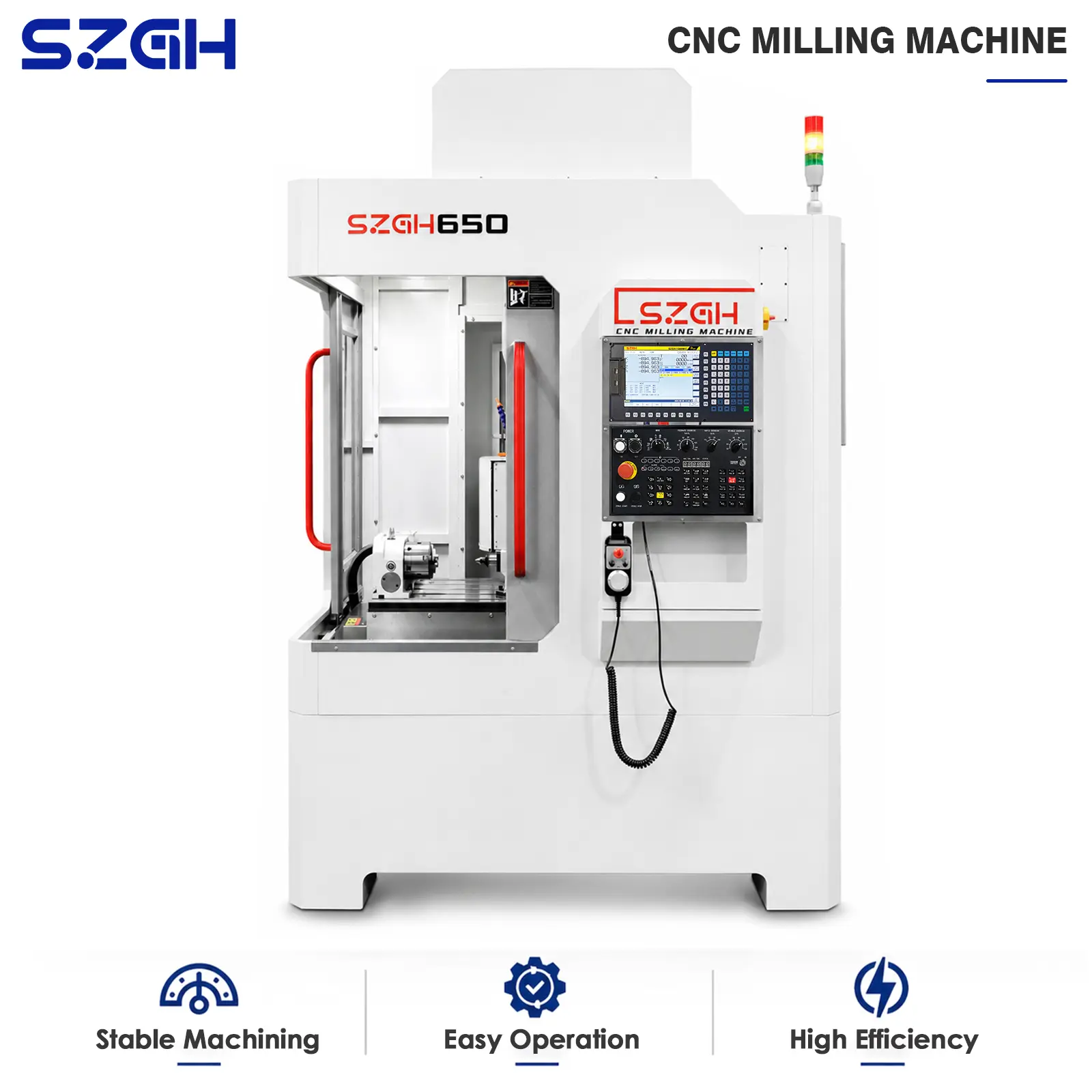
A vertical machining center can mill, drill, bore, and tap suitable printed components. The SZGH-VMC650 vertical machining center uses three-axis X, Y, and Z servo control. It is described for plates, shells, disks, cams, and molds, with an optional fourth rotary axis.
The SZGH-650 CNC milling machine supports milling, drilling, tapping, and engraving, with published working dimensions of 600 × 500 mm. It may suit secondary machining when the part and operations fit its capacity.
These machines are examples of CNC equipment that may serve the subtractive stage; they are not additive or integrated additive-subtractive machines. In a workflow-based hybrid process, printing and machining take place on separate equipment, potentially at different facilities. An integrated hybrid machine, by contrast, combines material deposition and machining within one machine platform. Do not confuse these concepts when planning an investment.
Review drawings and confirm dimensions, material, machining allowance, clamping access, tolerances, and configuration. A sample machining test can help verify suitability.
8. Is Hybrid Manufacturing Right for Your Business?
Before adopting the process, evaluate:
Part complexity: Is the geometry difficult or expensive to machine from solid stock?
Tolerance requirements: Which holes, surfaces, and interfaces need CNC finishing?
Material: Is the required material available through a suitable additive process?
Production quantity: Can the combined process be justified for the expected batch size?
Post-processing: What support removal, heat treatment, machining, and inspection are required?
Total cost: Have material, printing, labor, machining, tooling, inspection, and equipment costs been included?
Additive manufacturing followed by CNC finishing may suit customized or low-volume complex parts. Direct CNC machining may remain more practical for high-volume conventional parts. Compare the complete manufacturing route, not just printing or cutting.
Conclusion
Additive and subtractive manufacturing can complement each other. Additive processes provide design freedom and can create complex or near-net-shape components, while CNC milling and turning finish the features that require dimensional control and suitable surface quality.
This combination can be useful in aerospace, tooling, medical equipment, and specialized industrial production. The right decision starts with the part's geometry, material, tolerances, and production volume. By planning the entire process and selecting suitable CNC equipment for secondary machining, manufacturers can determine whether a hybrid workflow offers a practical production advantage.
Looking for CNC machining equipment for your production process?
Explore SZGH CNC machine solutions and contact our team to discuss your workpiece dimensions, materials, machining requirements, and suitable machine configurations.