3 Axis vs 5 Axis CNC Machining Which One Do You Need
Introduction
Choosing between 3 axis and 5 axis CNC machining is an important decision for manufacturers planning to improve their production capabilities. Both technologies offer precise and repeatable machining, but they differ in flexibility, workpiece positioning, programming requirements, and investment costs.
A 3 axis CNC machine moves the cutting tool or workpiece along the X, Y, and Z axes. It is widely used for milling, drilling, tapping, and machining components with relatively accessible surfaces.
A 5 axis CNC machine adds two rotational axes, allowing the cutting tool and workpiece to approach different surfaces and angles. This makes it particularly useful for complex components that require machining from multiple directions.
However, more axes do not automatically mean better productivity. The right choice depends on workpiece geometry, production volume, accuracy requirements, machining operations, and budget. This guide explains the differences and helps manufacturers determine which solution is suitable for their applications.
What Is 3 Axis CNC Machining
A 3 axis CNC machine operates along three linear axes:
X axis: Moves left and right.
Y axis: Moves forward and backward.
Z axis: Moves up and down.
These movements allow the cutting tool to machine different features on the accessible surfaces of a workpiece.
Three-axis CNC milling machines are commonly used for producing flat surfaces, pockets, slots, holes, and contours. They are suitable for many general manufacturing applications, including aluminum components, steel brackets, machine housings, and industrial fixtures.
Advantages of 3 Axis Machining
Lower investment cost: Three-axis machines generally require less complex mechanical structures and control systems than full 5-axis solutions.
Simpler programming: Toolpaths are easier to generate and verify for many conventional milling operations.
Easier operation: Operators and programmers can learn standard 3-axis machining workflows relatively quickly.
Wide application range: Many industrial components can be produced without additional rotational axes.
For example, a manufacturer producing aluminum mounting plates with drilled holes, milled pockets, and flat surfaces can often complete the required operations using a 3 axis CNC milling machine.
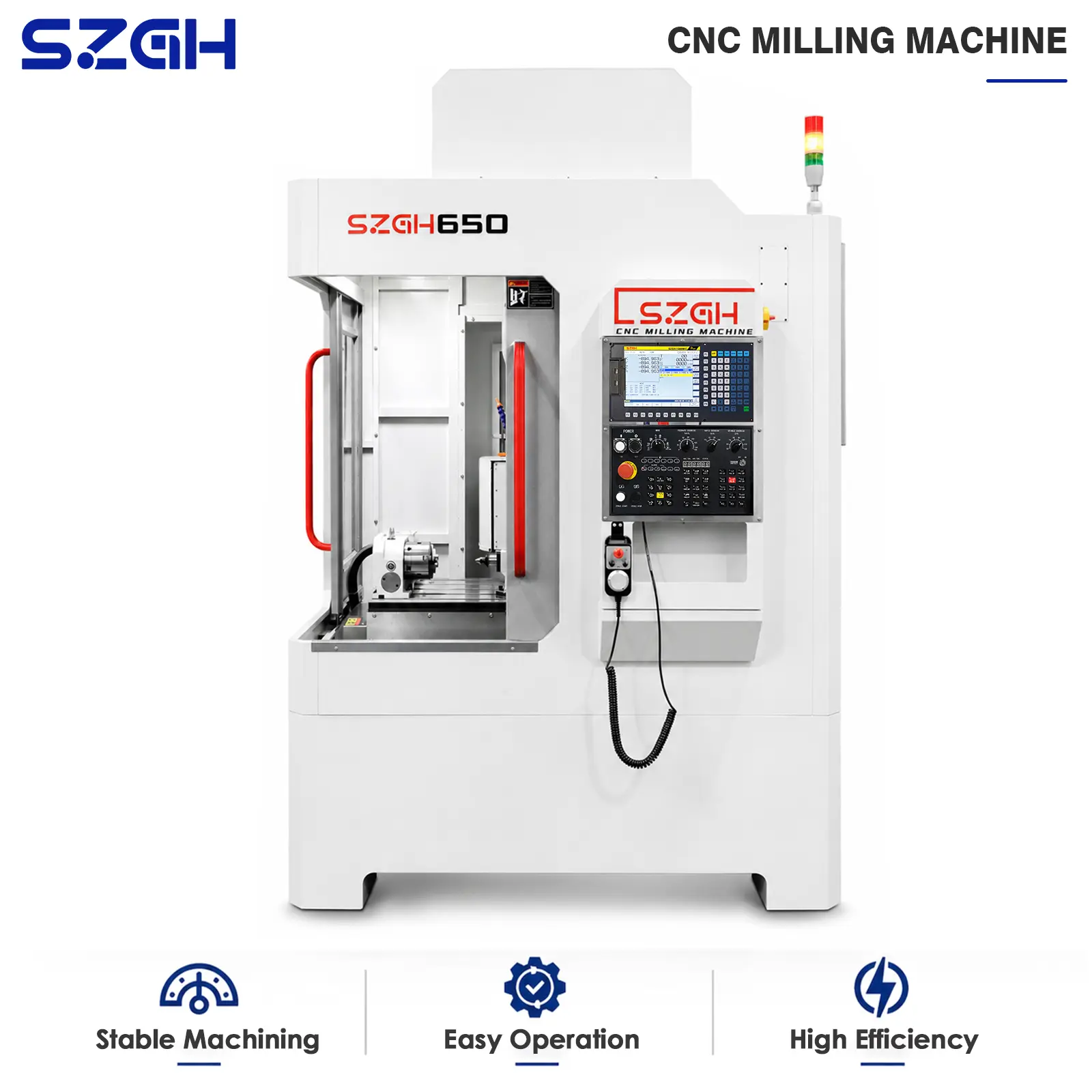
The SZGH-650 CNC milling machine is designed for machining copper, iron, aluminum, and stainless steel workpieces within its specified working range. It supports milling, drilling, tapping, and engraving operations.
Explore the SZGH-650 CNC Milling Machine.
What Is 5 Axis CNC Machining
A 5 axis CNC machine combines three linear axes with two rotational axes. Depending on the machine design, these rotational axes may tilt or rotate the workpiece, the cutting tool, or both.
This additional movement allows the cutting tool to approach a component from different directions without manually repositioning the workpiece after every operation.
Five-axis machining is especially useful for complex geometries, angled surfaces, curved profiles, and components requiring machining on multiple sides.
Advantages of 5 Axis Machining
Machining multiple surfaces: Different sides of a component can be accessed with fewer manual repositioning operations.
Reduced setups: Completing more operations in one clamping can reduce alignment errors and setup time.
Improved tool access: The cutting tool can approach complex surfaces from different angles.
Greater geometric flexibility: It supports applications involving curved surfaces, inclined features, and complex contours.
Potentially shorter machining cycles: Fewer workpiece transfers and more efficient tool orientations can improve overall production time for suitable components.
However, a 5 axis machine also introduces more demanding programming, simulation, collision checking, and operator training requirements.
3 Axis vs 5 Axis CNC Machining Key Differences
The following table summarizes the main differences.
Comparison Factor | 3 Axis CNC Machining | 5 Axis CNC Machining |
Main axes | X, Y, Z | X, Y, Z plus two rotational axes |
Machining directions | Primarily three linear directions | Multiple tool or workpiece orientations |
Part complexity | Simple to moderately complex | Complex multi-angle geometries |
Workpiece setups | May require multiple setups | Can reduce setups for suitable parts |
Programming | Generally simpler | More advanced CAM programming |
Collision management | Usually less complex | Requires more extensive simulation |
Initial investment | Generally lower | Generally higher |
Typical applications | Plates, brackets, housings, pockets | Complex molds, impellers, aerospace components |
The important distinction is that a 5 axis machine offers additional positioning freedom. Whether that freedom creates real production value depends on the actual component.
Which Applications Need 3 Axis or 5 Axis Machining
Selecting the correct machine begins with the engineering drawing.
Applications Suitable for 3 Axis Machining
Three-axis machining is often sufficient for:
Aluminum plates and mounting brackets
Machine bases and structural components
Flat surfaces with drilled holes
Components with pockets and slots
General-purpose mechanical parts
Small and medium-sized mold components with accessible surfaces
For these applications, a well-configured 3 axis CNC machine can provide the required accuracy and production efficiency without unnecessary mechanical complexity.
Applications Suitable for 5 Axis Machining
Five-axis machining becomes more valuable when components require:
Complex curved surfaces
Multiple angled machining features
Deep cavities with difficult tool access
Impellers and turbine-related components
Complex aerospace structural parts
Mold surfaces requiring different tool orientations
For example, an impeller may contain multiple curved blades that are difficult to machine efficiently using only three linear axes. Additional rotational movement allows the cutting tool to approach these surfaces from more suitable directions.
The decision should always consider the complete manufacturing process, including tooling, fixtures, programming, inspection, and production volume.
Does 5 Axis Machining Always Provide Better Accuracy
Not necessarily. More axes provide greater machining flexibility, but they do not automatically guarantee higher accuracy.
Final machining accuracy depends on several factors:
Machine structure and mechanical rigidity
Positioning accuracy and repeatability
Spindle condition and tool runout
Workpiece clamping and fixture stability
Thermal stability
Cutting tools and machining parameters
Calibration of rotational axes
One major advantage of 5 axis machining is the ability to complete multiple surfaces in fewer setups. Reducing repeated clamping can help maintain the positional relationship between different features.
However, rotational-axis calibration and machine kinematics also introduce additional factors that must be controlled.
For parts that can be accurately produced in three axes, a high-quality 3 axis machine may be the more practical and economical solution.
Cost Comparison Between 3 Axis and 5 Axis CNC Machines
The purchase price is only one part of the total investment. Manufacturers should also consider programming, tooling, maintenance, labor, and production efficiency.
Cost Factor | 3 Axis Solution | 5 Axis Solution |
Initial investment | Generally lower | Generally higher |
Programming | Simpler for conventional parts | More complex for multi-axis operations |
Tooling | Standard milling tools may be sufficient | Specialized tools or holders may be needed |
Setup time | May require additional repositioning | Can reduce setups for suitable parts |
Training | Generally less demanding | Requires additional programming and operating skills |
Maintenance | Less rotational-axis complexity | Additional rotary-axis maintenance and calibration |
For high-volume production of relatively simple components, 3 axis machining may offer a lower cost per part.
For complex components requiring several setups on a 3 axis machine, 5 axis machining may reduce total production time and improve consistency.
The best investment should be evaluated using actual production data rather than the number of machine axes alone.
Is There an Alternative Between 3 Axis and 5 Axis Machining
Yes. Manufacturers do not always need to purchase a dedicated full 5 axis machining center to improve multi-face machining capabilities.
A 3 axis CNC machine can sometimes be upgraded with a fourth or fifth rotary axis, depending on the machine structure, controller, and available configuration.
For example, SZGH offers configurations based on the SZGH-540 and SZGH-650 that can add a 4-axis or 5-axis rotary table. This allows suitable components to be machined from multiple directions in one clamping.
The SZGH-VMC650 also supports an optional fourth rotary axis for special machining applications.
It is important to distinguish between indexed multi-face machining and simultaneous 5-axis machining. A rotary-table upgrade does not automatically mean that the machine supports continuous simultaneous 5-axis interpolation. The actual linkage capability, controller functions, rotary-axis specifications, and software compatibility must be confirmed.
Explore the SZGH-540 and SZGH-650 with 4 or 5 Axis Rotary Table Options.
How to Choose the Right CNC Machine for Your Factory
Before purchasing a CNC machine, consider the following questions:
1. What parts do you manufacture? Review workpiece geometry and identify whether most features are accessible from three directions.
2. How many setups are required? Determine whether additional rotational axes would significantly reduce repositioning.
3. What accuracy is required? Check tolerances, surface finish, and inspection requirements.
4. What is your production volume? Compare setup savings with actual machining time and investment.
5. Do you have suitable programming skills? Consider CAM software, operator training, and technical support.
6. What are your future production plans? Choose equipment that supports realistic future requirements without unnecessary investment.
Providing engineering drawings, material information, annual production volume, and machining requirements to the machine supplier will make the selection process more accurate.
Frequently Asked Questions
1.Is 5 axis CNC machining better than 3 axis machining
Five-axis machining provides greater positioning flexibility and is better suited to many complex components. However, 3 axis machining is often more economical for conventional milling operations. The best choice depends on the workpiece and production requirements.
2.Can a 3 axis CNC machine machine complex parts
Yes. Many complex components can be produced using a 3 axis machine through multiple setups and suitable fixtures. However, additional setups may increase production time and alignment challenges.
3.Can a 3 axis CNC machine be upgraded to 5 axis
Some machines can be equipped with additional rotary-axis hardware, depending on their mechanical structure and controller capabilities. The upgrade may require a rotary table, compatible drives, control-system functions, and appropriate programming support.
4.Is 5 axis machining more expensive
Generally, 5 axis equipment requires a higher initial investment and more advanced programming. However, it may reduce total manufacturing costs when it significantly reduces setups and machining time.
5.What is the difference between 3+2 machining and simultaneous 5 axis machining
In 3+2 machining, the two rotary axes position the workpiece or tool at a selected angle, and the three linear axes perform the cutting operation. In simultaneous 5 axis machining, all five axes can move together during cutting. The latter is necessary for certain complex continuous surface machining applications.
Conclusion
The choice between 3 axis and 5 axis CNC machining should be based on workpiece complexity, required operations, production volume, accuracy, and investment budget.
Three-axis machining remains an effective solution for many conventional manufacturing applications, offering straightforward programming and cost-efficient production. Five-axis machining provides additional flexibility for complex geometries and multi-angle machining operations.
For manufacturers who need more machining flexibility without immediately investing in a dedicated 5 axis machine, a compatible rotary-table upgrade may also be worth evaluating.
Looking for the right CNC machining solution? Share your part drawings, materials, machining requirements, and expected production volume with SZGH. Our team can help evaluate suitable 3 axis, 4 axis, and 5 axis rotary-table configurations for your application.