How to Choose the Right CNC Lathe for Metal Parts Manufacturing?
Choosing a CNC lathe is a long term production investment. Although machine price is an important consideration, it should not be the only factor when selecting equipment. The right CNC lathe needs to match the workpiece size and material, required machining operations, accuracy, spindle performance, and future production requirements.
If the machining capacity is too small, the machine may limit production and prevent the factory from processing certain parts. On the other hand, choosing a machine with excessive capacity can increase the initial investment without providing a corresponding improvement in production efficiency.
This guide explains the key factors to consider when selecting a CNC lathe machine and how different SZGH models can be matched with common metalworking requirements.
1.Start With the Workpiece Requirements
When choosing a CNC lathe, the first step is to clearly understand what type of parts the machine needs to process.
Before contacting a CNC lathe supplier, it is recommended to prepare the following information:
Maximum workpiece diameter
Maximum machining length
Bar diameter
Workpiece material
For example, a manufacturer producing small brass or aluminum components from bar stock will have very different requirements from a factory machining long shafts or larger stainless steel components.
Therefore, the CNC turning machine should be selected according to the largest realistic production requirements, rather than simply using the average dimensions of current parts as the selection standard.
2.Match the CNC Lathe With Your Production Requirements
SZGH provides several CNC turning machine configurations for different workpiece sizes and machining applications.
Model | Typical Application | Bar Capacity | X Axis Travel | Z Axis Travel |
Small precision bar parts | Up to 25 mm | 500 mm | 180 mm | |
Small and medium turning parts | Up to 35 mm | 600 mm | 240 mm | |
Larger precision turning parts | Up to 45 mm | 1000 mm | 370 mm | |
Turning and side milling | Up to 35 mm | 600 mm | 240 mm | |
Turning milling and drilling | Up to 45 mm | 1000 mm | 400 mm |
These different configurations allow manufacturers to select a machine according to their actual production requirements instead of using the same CNC lathe configuration for every application.
For more information about the available models, see the SZGH CNC lathe machine range.
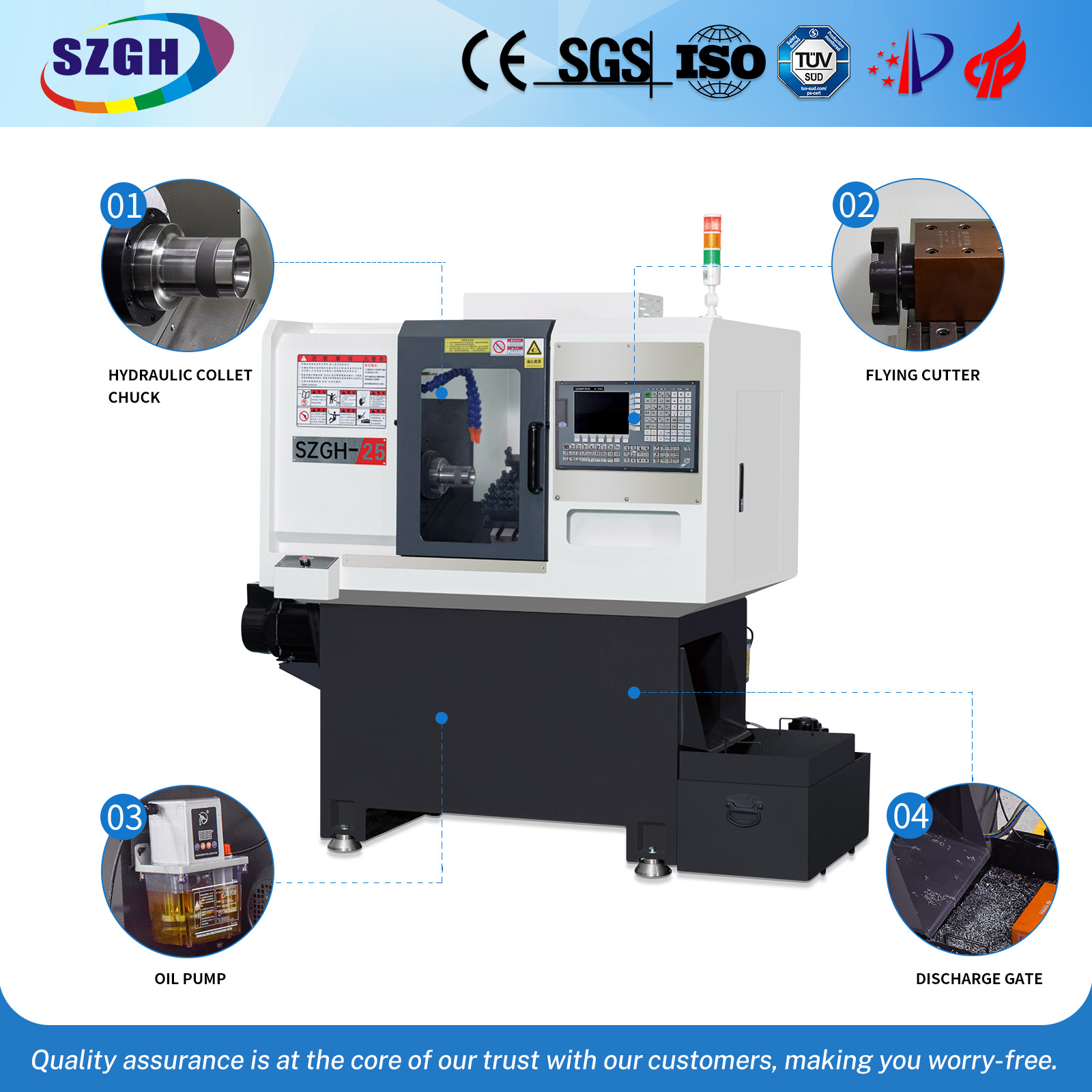
SZGH-25 for Compact CNC Turning Applications
The SZGH-25 is designed for machining bar materials up to 25 mm. It uses a 30 degree slant bed structure, with 500 mm X axis travel and 180 mm Z axis travel.
The machine is equipped with a 4 kW spindle motor as standard, with a 3.7 kW servo spindle available as an option.
For manufacturers producing large quantities of relatively small components, a compact CNC lathe machine can provide sufficient machining capacity while avoiding unnecessary investment in a larger machine.
SZGH-36J for Small and Medium Turning Parts
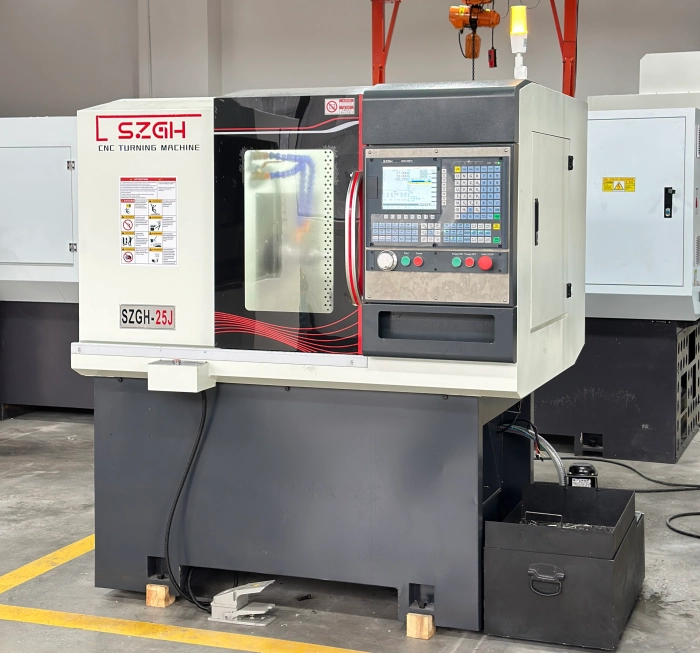
The SZGH-36J increases the bar processing capacity to up to 35 mm, with 600 mm X axis travel and 240 mm Z axis travel.
The machine uses a 4 kW spindle configuration as standard, with a servo spindle option available.
When a 25 mm class machine does not provide enough capacity but a larger 45 mm turning platform is not necessary, the SZGH-36J can provide an appropriate intermediate configuration.
You can also review the SZGH-36J CNC lathe for additional model information.
SZGH-46J for Larger and Longer Turning Parts
When production involves larger bar materials or longer workpieces, the SZGH-46J provides a larger machining range.
The model supports bar materials up to 45 mm, with approximately 1000 mm X axis travel and 370 mm Z axis travel. The machine uses a 5.5 kW spindle as standard and offers a 7.5 kW servo spindle option.
For manufacturers requiring a larger turning range, the SZGH-46J CNC lathe provides additional product information.
3.Determine Whether You Need Turning and Milling
The machining process is another important factor when selecting a CNC lathe.
If a component mainly requires turning, a conventional CNC turning machine may be sufficient. However, some parts require additional operations after turning, such as:
Side drilling
End face drilling
Tapping
Slot milling
Side milling
Other milling operations
If these operations are performed on separate machines, the workpiece must be transferred and clamped again. This adds handling time and creates another opportunity for positioning errors.
In such applications, a CNC turning and milling machine can combine multiple operations in a single setup.
SZGH-36Y Turning and Milling Machine
The SZGH-36Y is based on the SZGH-36 CNC lathe platform and adds four Y axis side power heads.
This configuration can combine turning with side drilling, tapping, slotting, and other machining operations.
It can be useful when a component requires additional side machining after the main turning process.
SZGH-46Y Turning and Milling Machine
For more complex components, the SZGH-46Y uses a 4 plus 4 power head configuration and an 8 station servo turret.
This configuration allows turning, drilling, tapping, and milling operations to be combined on one machine.
Potential production advantages include:
Reduced workpiece transfers
Fewer secondary setups
Less manual handling
Reduced risk of positioning errors
More machining operations completed on one machine
Therefore, machine selection should not only ask how large the machine is, but also how many machining operations a single part requires.
4.Consider Spindle and Tooling Configuration
After determining workpiece size and machining operations, the next step is to evaluate the spindle and tooling configuration.
The appropriate spindle configuration depends on the workpiece material, cutting conditions, required speed control, torque requirements, and production process.
Higher spindle power is not automatically better for every application. The spindle should be selected according to the actual cutting process.
For example, the spindle requirements for aluminum machining may differ from those for stainless steel machining. Tool diameter, cutting depth, feed rate, and surface finish should also be considered.
5.Consider Future Production Requirements
A CNC lathe is normally used for many years, so machine selection should not focus only on current production requirements.
For example, if current parts use 28 mm bar stock but future products may require 35 mm bar stock, selecting a machine in the 36 mm class can provide additional production flexibility.
However, excessive machine capacity can also increase the initial investment. If the factory mainly produces small components, a much larger CNC turning machine may not necessarily improve production efficiency.
A practical selection should balance:
Workpiece requirements + machining process + machine configuration + future production flexibility
This approach helps manufacturers avoid both insufficient machine capacity and unnecessary investment.
6.Prepare Technical Information Before Requesting a Quotation
Providing detailed technical information can make the machine selection process much more accurate.
Before contacting a supplier, prepare:
Workpiece Information
Part drawings
Material
Maximum diameter
Maximum length
Bar diameter
Workpiece weight
With this information, the supplier's engineering team can evaluate the complete machining process and recommend a suitable CNC lathe configuration.
7.FAQ
Q1:What should I consider first when choosing a CNC lathe?
Start with the workpiece. Maximum diameter, bar size, machining length, material, tolerance, and required machining operations determine the basic machine capacity.
Q2:Which CNC lathe is suitable for small bar stock parts?
The SZGH-25 supports bar materials up to 25 mm, while the SZGH-36J supports bar materials up to 35 mm. The appropriate choice depends on the actual production range.
Q3:When should I choose a turning and milling machine?
A turning and milling machine should be considered when a component requires turning together with drilling, tapping, slot milling, or other side or end face machining operations.
8.Conclusion
Choosing the right CNC lathe requires more than comparing machine prices. Workpiece dimensions, bar capacity, machining operations, spindle configuration, tooling, accuracy, and future production requirements all affect the final machine configuration.
For small bar stock components, the SZGH-25 provides a compact CNC turning solution. For a wider range of small and medium components, the SZGH-36J provides greater bar capacity. For larger or longer turning applications, the SZGH-46J offers a larger machining range.
When components also require milling, drilling, or tapping, the SZGH-36Y and SZGH-46Y turning and milling configurations can help combine more operations into a single setup.
The most important starting point for CNC lathe selection is always the actual workpiece and machining process.
By providing part drawings and detailed production requirements, manufacturers can identify a CNC machine configuration that meets current production needs while allowing reasonable flexibility for future applications.
9.Get CNC Lathe Selection Support
If you are planning to purchase a CNC lathe or replace existing turning equipment, prepare your part drawings, material, dimensions.
The SZGH technical team can evaluate your application and recommend a suitable CNC lathe or turning and milling configuration.
You can also request the latest SZGH CNC machine catalog to compare machine models and available configurations.