As global manufacturing shifts toward higher efficiency, stricter tolerance demands, and reduced labor reliance, traditional standalone machining operations are fast giving way to smart, automated manufacturing cells.
Among these technological advances, one synergy stands out: the seamless integration of CNC machine tools and industrial robots. By combining high-precision turning and milling machinery with flexible, highly repetitive robotic loading/unloading arms, manufacturers can unlock true "lights-out" unattended production.
In this article, we examine how pairing CNC machine tools with industrial automation solutions is transforming modern shop floors, key application scenarios, and how SZGH’s integrated technology ecosystem powers this transformation.
1. Why Integrate CNC Machines with Industrial Robots?
In conventional CNC machining setups, manual material handling introduces bottlenecks, operator fatigue, cycle time variance, and potential safety risks. Robotic machine tending directly addresses these limitations:
Ÿ 24/7 Unattended "Lights-Out" Operation: Robots do not experience fatigue or require shift changes. Paired with automatic bar feeders or raw billet tray systems, a CNC turning or milling machine can operate continuously across overnight shifts.
Ÿ Consistent Cycle Times & Higher Efficiency: Industrial robots execute loading, clamping, unloading, and deburring with sub-second repeatability, eliminating human delay and optimizing overall equipment effectiveness (OEE).
Ÿ Enhanced Safety & Reduced scrap rates: Automated handling shields workers from hot metal chips, sharp coolant spray, and heavy lifting while eliminating manual positioning errors during part clamping.
Ÿ Multi-Machine tending Capability: A single floor-mounted or overhead track-mounted 6-axis robot can service two, three, or more CNC lathes or machining centers simultaneously, maximizing equipment utilization per square meter.
2. Core Application Scenarios in Automated Machining Cells
The combination of CNC machines and robotic handling arms excels across a wide range of high-volume and precision manufacturing environments:
Automated Shaft & Disc Turning Line
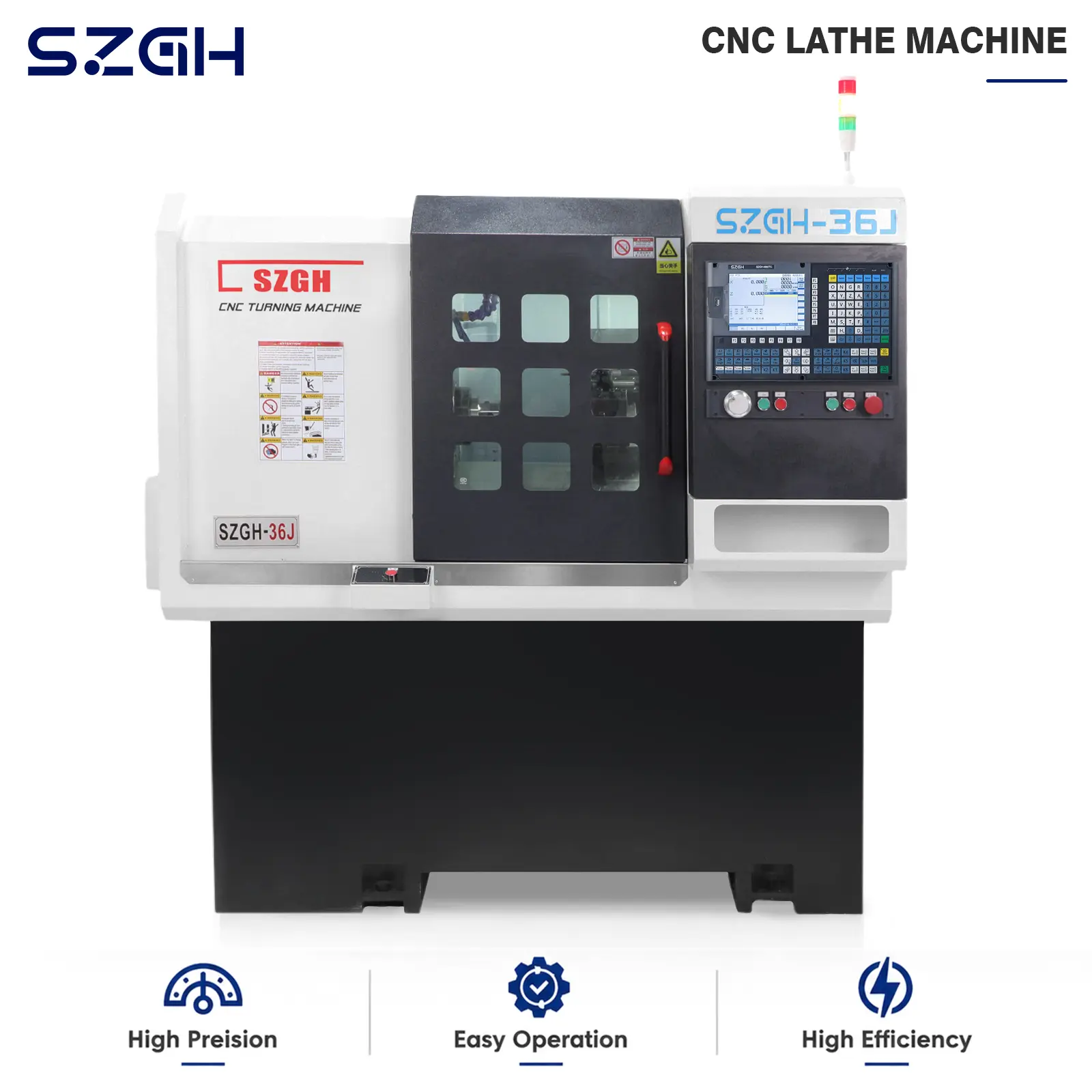
Ÿ Workflow: A 6-axis robot (such as the SZGH-T1000-C-6) retrieves raw steel or aluminum round stock from a staging conveyor, loads it into a high-precision CNC lathe (like the SZGH-36J or SZGH-46Y), triggers automatic pneumatic/hydraulic chucking, signals the machine cycle start, and transfers the turned component to a blowout or inspection station.
Multi-Axis Turn-Mill Complex Machining
Ÿ Workflow: For intricate parts requiring both turning and Y-axis milling, robots precise-orient workpieces into multi-station clamping fixtures, ensuring accurate alignment between primary turning operations and secondary milling/drilling setups.
Post-Processing Integration (Deburring & Cleaning)
Ÿ Workflow: Beyond loading and unloading, end-of-arm tooling (EOAT) can be equipped with pneumatic grippers and air nozzles to blow away chips, dip parts in rust-preventative baths, or perform online deburring before palletizing finished parts.
3. The SZGH Advantage: Unified Control and One-Stop Integration
A major hurdle in traditional machine-tending projects is the complex communication protocol between third-party CNC controllers and external robotic arms. SZGH solves this pain point through unified system synergy.
1.Seamless Bus Communication & Controller Compatibility: SZGH designs both CNC control systems (such as the SZGH-880TC / CNC1000T series) and 6-axis industrial robot controllers. Standardized I/O signals and Modbus/Ethernet protocols eliminate signal handshake delays and complex programming interfaces.
2.Complete In-House Ecosystem: From high-rigidity slant-bed CNC lathes and precision servo drives to customized 6-axis articulated robots (handling payloads from 6kg to 50kg+), SZGH delivers a fully verified turnkey automated cell.
3.Flexible Gripper & Auxiliary Equipment Customization: Turnkey cells can be integrated with vision positioning systems, automatic pneumatic chucks, part blow-off units, and customized rack feeders.
4. Conclusion & Transitioning to Automated Manufacturing
The integration of CNC machine tools and industrial robots is no longer an optional upgrade for high-tech enterprises—it is an essential strategy for machine shops aiming to maintain cost efficiency, product consistency, and international competitiveness.
Ready to upgrade your production floor to an automated, robotic CNC cell?
Contact the SZGH automation engineering team today to share your workpiece drawings and daily throughput targets. We will customize a complete, high-efficiency robotic machine-tending proposal for your factory.